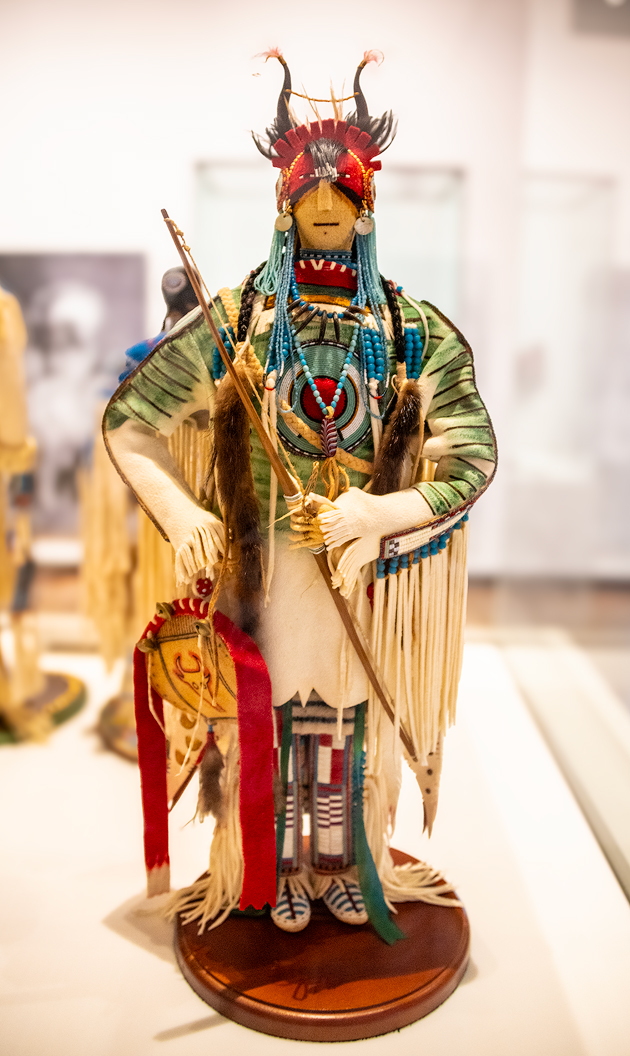
Rhonda Holy Bear was born and raised on the Cheyenne Sioux Reservation in South Dakota. She made her first doll out of scraps of cloth at the age of four. Holy Bear was placed in a government-run school when she was seven. At age 14, she moved to Chicago to live with a relative. Chicago offered great options for viewing and appreciating art, particularly at the Art Institute of Chicago and the Field Museum. Holy Bear spent hours at the museums and became fascinated with Plains beadwork and quillwork.

Holy Bear's early dolls had simplified facial features. As she continued to research and develop her work, she began to carve detailed facial features out of wood. Holy Bear pays close attention to every detail. She has received significant recognition for her dolls, including First Place awards at the Southwestern Association of Indian Arts Market in Santa Fe and the Heard Museum Guild Indian Fair & Market, as well as the 2019 Best of Classification award at the Heard.
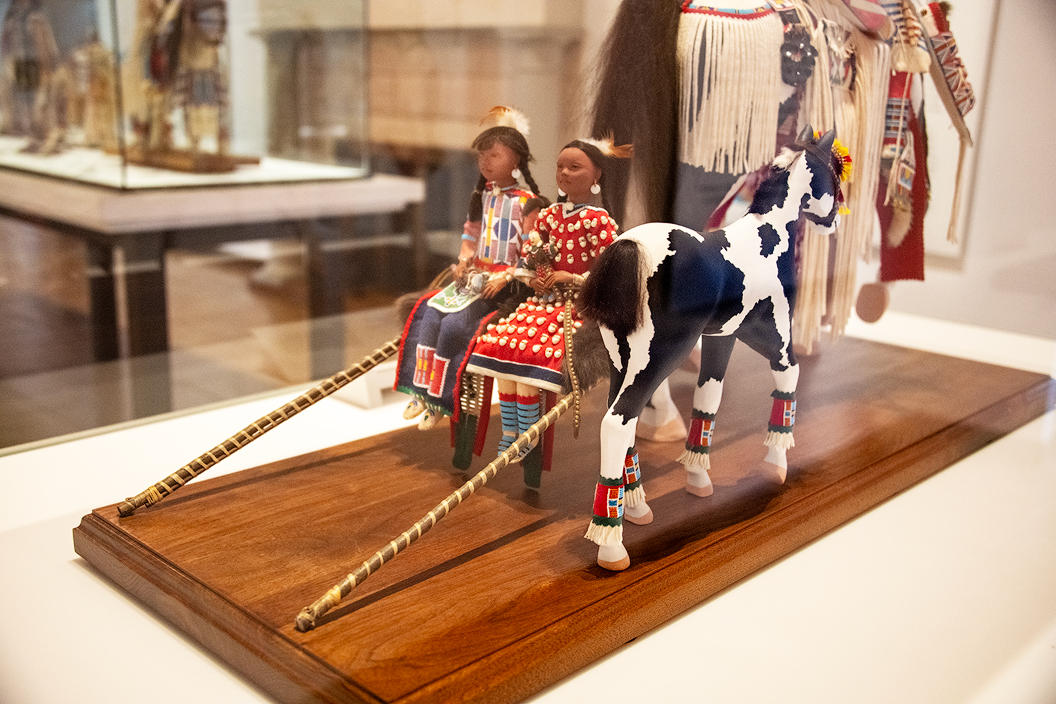
GRAND PROCESSION: These dolls were collected by Charles and Valerie Diker, who have collected Native American art for more than 40 years.
This piece is by Juanita Growing Thunder Fogarty and her mother, Joyce Growing Thunder of the Assiniboine/Sioux tribe. Juanite said, "There is nothing fast about what we do. Everything is tedious. From sorting quills to the tiny fine beadwork. You can't do it if you're upset. You make mistakes and have to backtrack. Mom always told me that you have to work on things in a good way...because you are putting yourself — your prayers and your thoughts — into your work.
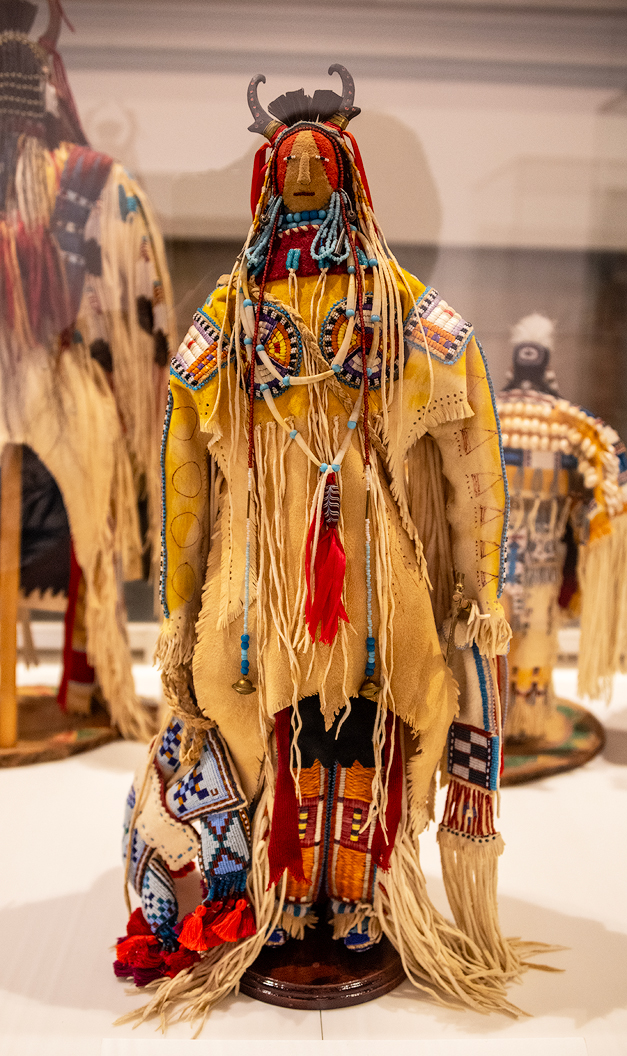
The artist, Juanita Growing Thunder Fogarty, states: "The chief has bear medicine. I was not honoring anyone specific; it was just a concept in my mind. The hair is human hair bought from a wig store. When mom first started making the figures she used our hair, but that was not going to work for very long."
The richly painted and beaded imagery includes bear paws, animal tracks, morning star, horses, and the concept of mirroring — what is above is below — symbolized by the double cones on the
beaded bag.
The artist is Juanita Growing Thunder Fogarty, Assiniboine/Sioux. She calls it "Chief with Homed Headdress", incorporating 1999 Hide, cloth, glass beads, porcupine quills, pigment, hair, feathers, silk ribbon, embroidery thread, dentalium shells,
metal, and wood.
In addition to his quilled, painted, and perforated shirt, the chief wears a horned headdress with cut featherwork — typical of an Assiniboine warrior. He also holds beaded saddle, and tobacco bags as well as a pipe and tomahawk.
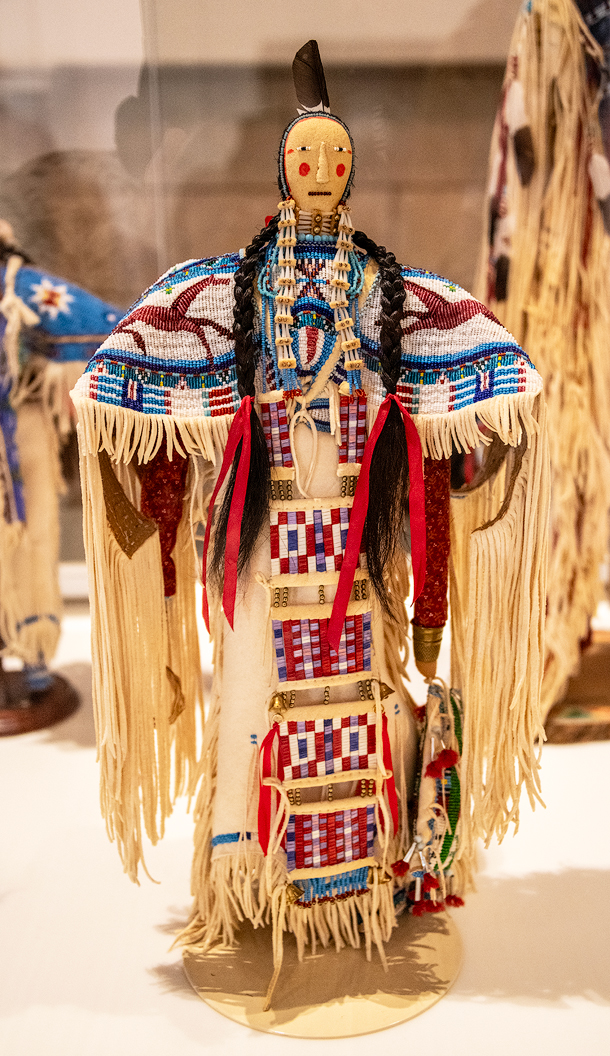
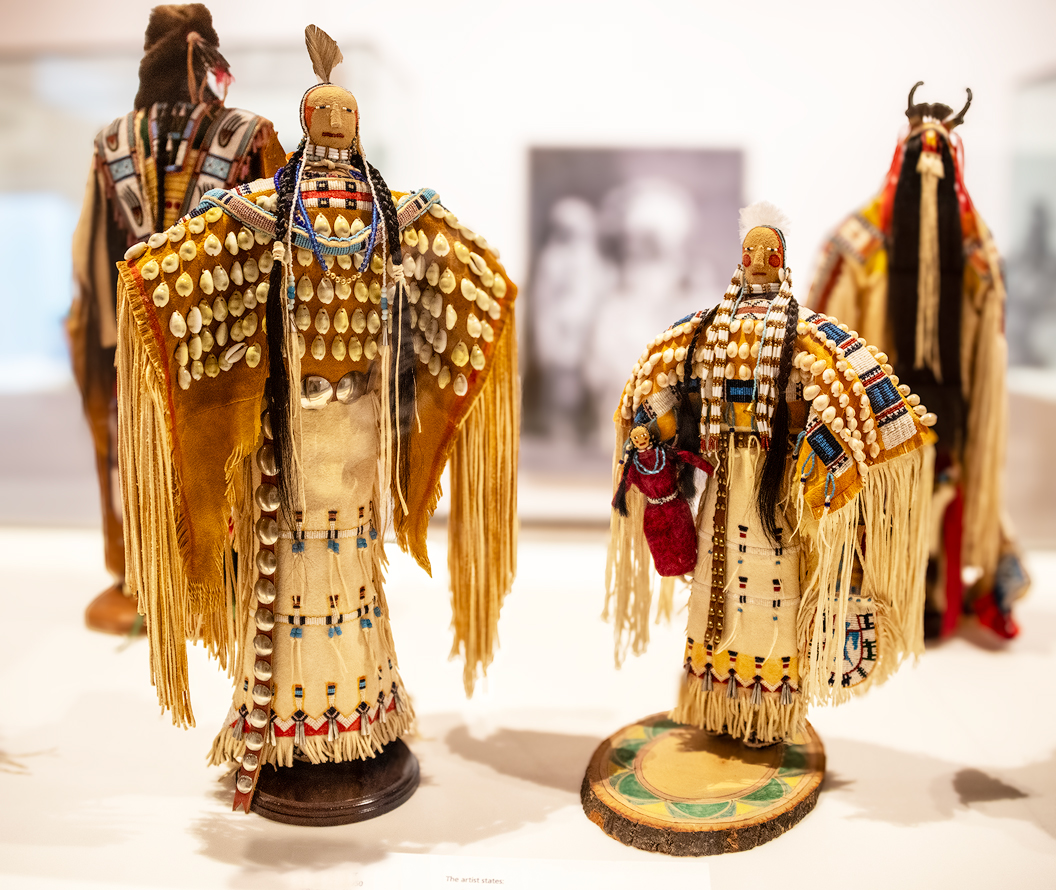
Juanita Growing Thunder Fogarty calls this piece "Sioux Woman. The beaded horse imagery on the yoke honors the importance of horses to the Plains people. A charming addition is the use of brass sewing thimbles for bracelets. Underneath the hide dress is another one of calico, a typical clothing style of the late 1800s to the early 1900s. On her back is a fully beaded cradleboard.
This piece by Joyce Growing Thunder Fogarty is entitled "Netacoda" and is a classic 19th-century Plains warrior style of dress. The beautifully painted shield on the warrior's back displays a buffalo head with emanating power lines, buffalo hooves, and a crescent moon. Shield imagery was a supernatural power received by a warrior in a dream or vision quest. Although a thick hide shield might deflect arrows in battle, its greater value was the spiritual protection given to the individual through the designs.
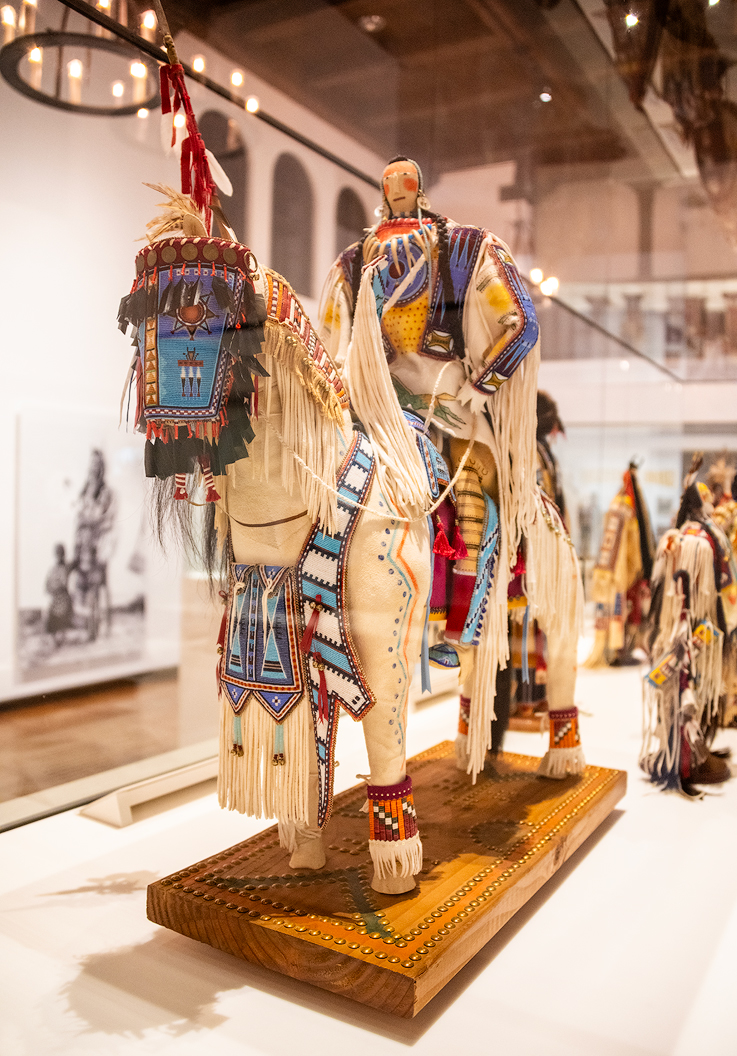
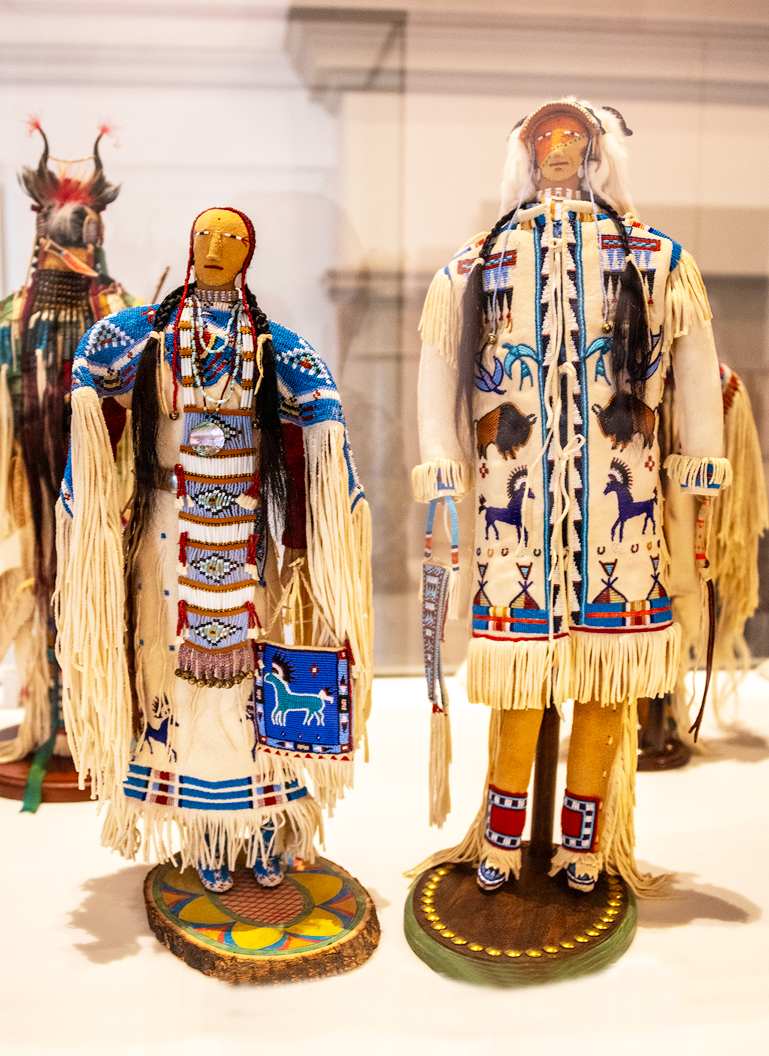
Joyce Growing Thunder made this pair of dolls to honor her grandparents, Ben Gray Hawk and Josephine Gray Hawk, who raised and taught her many of the traditional ways. The beaded images decorating Ben Gray Hawk's frock coat — itself a symbol of stature — illustrates many of the beings important within the Great Plains worldview. The horse with the war bonnet is biographical. Growing Thunder's grandparents held a celebration in which they gave away horses with attached eagle-feather war bonnets in honor of their grandchildren. Other designs include an eagle-feather staff, thunderbirds, buffalo, morning star, horse tracks, and a lodge with buffalo head.
Joyce Growing Thunder Fogarty states that "Dakota Warrior, First Chief" was the first male doll that I ever made. I knew that I wanted to do a quilled shirt. And I remember that I took great care in making him. He took a good long time, as I was learning. But I think that he turned out pretty well.
"Northern Cheyenne Women" is also by Joyce Growing Thunder who states: "One summer we lived on the Northern Cheyenne reservation in Montana, where we have adopted relatives, so I was very familiar with the designs. I enjoyed making these dolls and was very pleased with how they turned out."
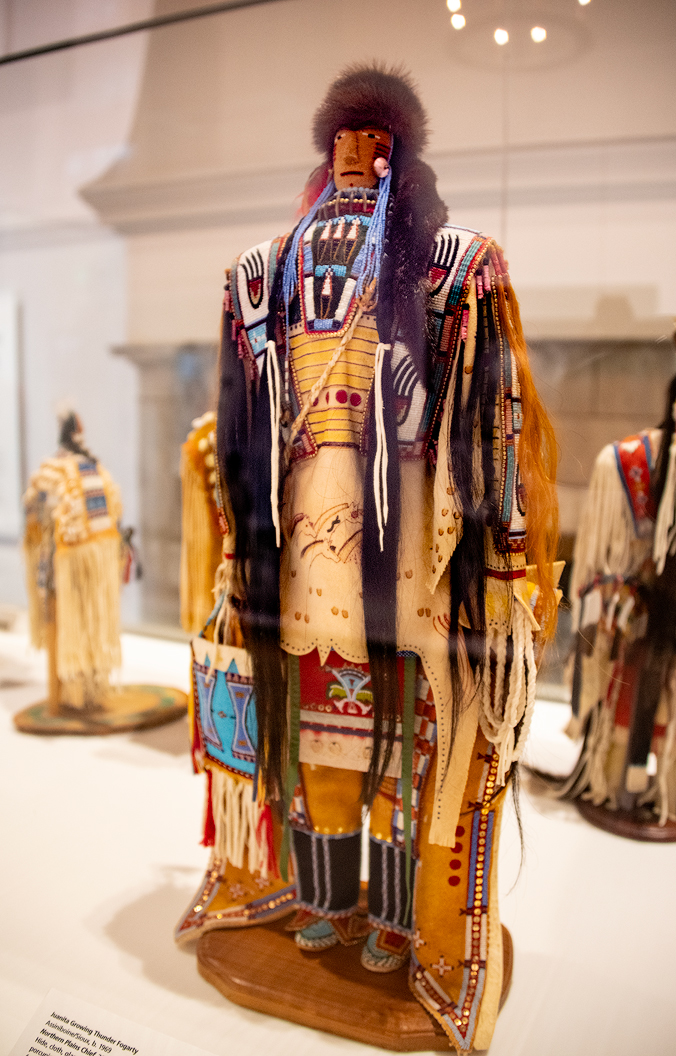
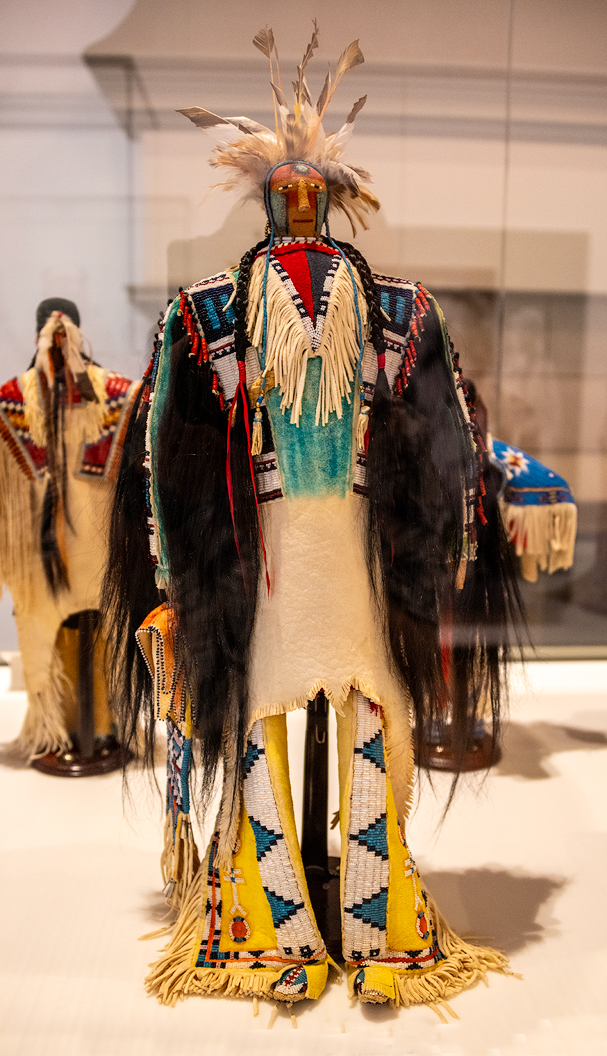
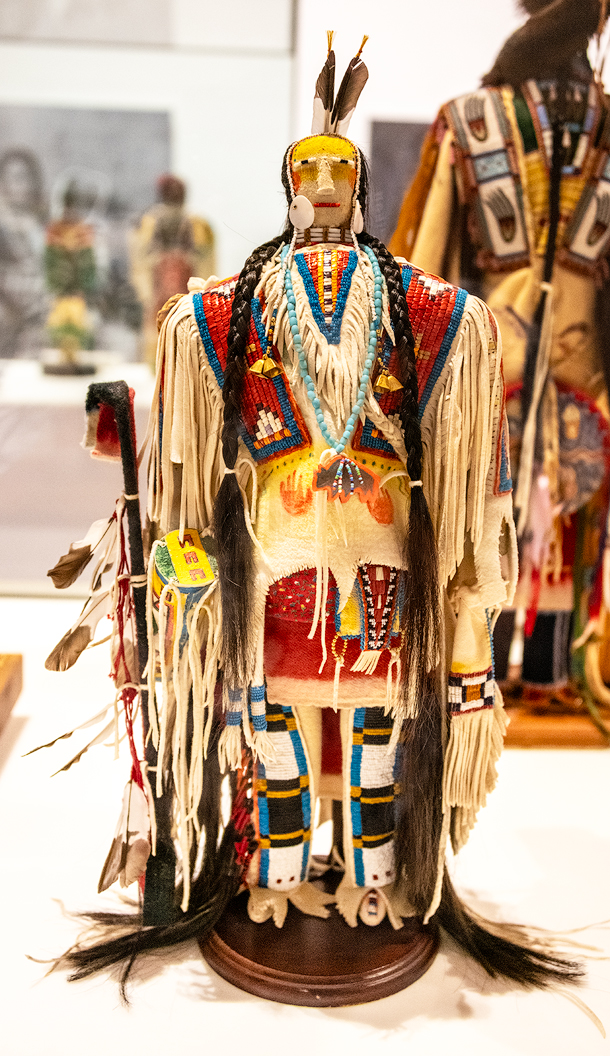
For "Teton Sioux Chief", Juanita Growing Thunder Fogarty describes the beadwork on the flaps of the leggings as: "medicine wheels with eagle feathers and dragonflies. The solidly beaded strips represent stars with mountains."
She interprets the designs on the sleeves:
"Held sideways, the design represents the meeting of
sky world and earth world. The yellow is the top of the mountain with the star in the center. It is the intermixing
of the two worlds — the spiritual and the daily a reminder that you are supposed to live within both."

Here we see "Sioux Woman with a Baby Carrier" also by
Juanita Growing Thunder Fogarty. She describes the intricate designs on this female doll with a cradleboard
as having: a fully beaded blue top that symbolizes a lake and the images reflected in the lake; several variations of star designs, dragonflies around the outside border and a turtle back in the yoke's center representing a version of the Sioux creation story. She wears a porcupine quilled breastplate; the designs are variations on stars and mountains.
On her back, she carries a fully beaded cradleboard with a baby. This style of cradleboard, with pointed wood supports, was outlawed on the Fort Peck Reservation for fear that it could be used as a weapon. The grass she carries in her hand is sweetgrass, meant to bring good medicine.

The artist, Juanita Growing Thunder, states: "The beaded leggings include designs symbolizing stars and horse tracks. The chief carries a tomahawk with a beaded drop incorporating eagle feather designs and a quilled fringe. The work is entitled, "Assiniboine Chief".

Juanita Growing Thunder Fogarty and Jessa Rae Growing Thunder worked together on this piece entitled
Buffalo Chaser.
Juanita Growing Thunder Fogarty states: This particular shirt was intended to be the sun or heart of the warrior with the thunderbird wings. The thunder on the high plains is a very frightening and powerful sound. Just imagine living in a tipi and hearing it, like the sound of another world. When these types of warriors went into battle they would wear their finest clothing, so that they could be dressed in the best way possible for the spirit world if it came to that. His powerful face paint was the final thing added. It is like a real person who puts their
makeup on last.