Commemorative Air Force, Arizona Wing, Part 9
I was still outside in the hot Arizona sun when I spotted, what appeared to be a mirage, but what actually turned out to be a DC-3 sporting an Army camouflage paint job. Now this really brings back old, old memories. My father used to tell a story about watching the televised dedication of the then new Friendship International Airport — now Baltimore-Washington International Airport. This took place June 24, 1950 when I was only four years old. My Uncle Whitey was visiting at the time and we saw a plane landing (as part of the ceremony, I now presume) and I pointed to the on-screen image and told my uncle that it was a DC-3. He was flabbergasted — how could a four-year-old kid recognize a DC-3. My guess was that it was because my dad used to take me to the airport (and its predecessor) to watch planes land — and he taught me to recognize this particular model.

 While the previous memory was from my dad, I also have a personal experience with the DC-3, in that it was one of the first aircraft I ever flew on. I was returning to college just prior to my sophomore year — this would have been 1965. The previous year I had taken the bus from my parents' home in Fort Lauderdale, FL to West Lafayette, IN where Purdue University is located. Twenty-four hours on a bus is terrible punishment for anyone so we decided that I would fly this year. Other than my dad's experience in the Army Air Corp, no one in my family had ever flown — and even he had never flown commercially.
First lesson learned — book non-stop or at least the fewest number of stops possible. I flew from Fort Lauderdale to Jacksonville to Cincinnati to Chicago on a jet airliner.
I then had to transfer to a DC-3 for the short flight back to West Lafayette. Sitting by the window, I watched as the pilots started the engines which emitted a huge cloud of smoke (burnt oil, i presume) together with the deafening roar of the engines. That did not give me a lot of confidence in the aircraft. Additionally, the entire flight was at a fairly low altitude, maybe two or three thousand feet.
Well, as you may have guessed, I survived and went on to experience many commercials flights and a few private aircraft flights thereafter.
 An interesting observation about the DC-3, although the windows are covered in this photo, they are rectangular which was common in those days. Most of you will recall that commercial jets today have rounded rectangular windows.
This change all dates back to the de Havilland DH 106 Comet, which was the first production commercial jetliner. Initially, it too had rectangular windows. Here is the rest of the story compliments of Wikipedia — "A year after entering commercial service the Comets began suffering problems, with three of them breaking up during mid-flight in well-publicized accidents. This was later found to be due to catastrophic metal fatigue, not well understood at the time, in the airframes. The Comet was withdrawn from service and extensively tested to discover the cause; the first incident had been incorrectly blamed on adverse weather. Design flaws, including dangerous stresses at the corners of the square windows and installation methodology, were ultimately identified; consequently the Comet was extensively redesigned with oval windows, structural reinforcement and other changes. Rival manufacturers meanwhile heeded the lessons learned from the Comet while developing their own aircraft."
Back inside to the coolness of the hangers, I next encountered a Boeing Stearman B75N1, biplane used by the military as a trainer during the 1930s and 1940s. I previously shared a photo of a very similar model, the VN2S, although with a very different paint job. These models served as the primary trainer for the USAAF, the US Navy and RCAF (where it was known as the Kaydet).

 Love the instrument panel.
 I also love the paint job — quite striking. After the war, thousands of these planes were sold to
civilians and former pilots. Some were modified to serve as cropdusters.
I also love the paint job — quite striking. After the war, thousands of these planes were sold to
civilians and former pilots. Some were modified to serve as cropdusters.
My friend, Billy, who is a retired commercial pilot and member of the CAF, flies one of these with several of his buddies in formation over our community several times a year. I am sure it is much fun for him but also enjoyable for those of us on the ground to watch them pass.
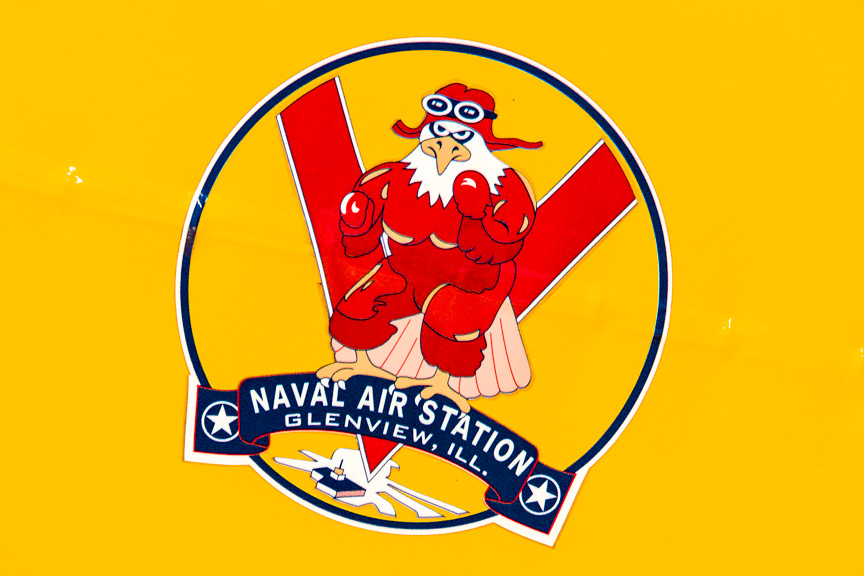 Part of the appeal of this paint configuration is the logo of the Naval Air Station in Glenview, IL. Although the base has been closed and re-purposed, it boasts some notable alumni.
- Astronaut Neil Armstrong, served as a Naval Aviator and Naval Reservist at NAS Glenview.
- Former President George H. W. Bush, received carrier pilot training as a Student Naval Aviator at NAS Glenview during World War II, in August 1943.
- Former President Gerald Ford, served at NAS Glenview from the end of April 1945 to January 1946, during World War II, as the Staff Physical and Military Training Officer.
- Rear Admiral Daniel Gallery, a Naval Aviator, commanded the Naval Air Reserve Training Command at NAS Glenview from 1952 to 1954. As a Navy Captain during World War II, Gallery led the task group which captured the German submarine U-505, which is now on display at Chicago’s Museum of Science & Industry.
- Lieutenant Commander Edward H. "Butch" O'Hare, a Naval Aviator and Chicago native, became the U.S. Navy's first World War II flying ace and Medal of Honor recipient.
- Meinhardt Raabe, who portrayed the coroner in The Wizard of Oz, served with the Civil Air Patrol at NAS Chicago/NASGlenview during World War II.
Leaving the CAF after a wonderful day of viewing and photographing aircraft, I paused to examine (and photograph) the anti-aircraft guns just outside the entrance. They are just another of the hazards that military pilots had to face and still must face.
If you enjoy vintage aircraft, I highly recommend a visit to this or any other CAF facility. Now that my dad has moved to Georgia, I hope to visit the branch there in the near future. They have a PT-26 which my dad flew when he was in training in the Army Air Corp. That would be quite a sentimental tour.
