RM Auction, Part 1
The last two weeks I shared photos of model cars — an exhibition that was sponsored by RM Auctions. The exhibit was an attraction designed to bring in potential customers for the auction of collectible automobiles. Interestingly, there were three auto auctions going on that same week, including the Barrett-Jackson auction which is bigger and which I have shared with you before.
But size did not preclude some fine examples of automotive excellence. Here is a 1931 Cadillac V-12 Town Sedan — Series 370A. 150 hp, 368 cu. in. OHV V-12 engine, three-speed Selective Synchro-mesh transmission, ¾-floating rear axle, and four-wheel mechanical drum brakes with vacuum assist. Wheelbase: 140 in.

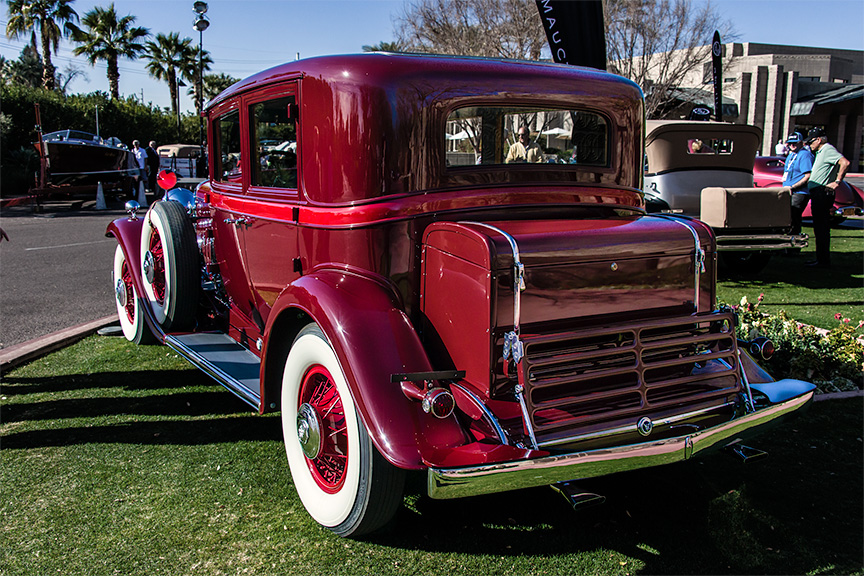 The expected selling price was in the $100K to $125K range with no reserve. It actually sold for $49.5K.
 The next vehicle I encountered was a 1930 Lincoln Model L Sport Phaeton — 90 hp, 384.8 cu. in. L-head V-8 engine, three-speed manual transmission, solid front axle with semi-elliptic leaf springs, live rear axle with semi-elliptic leaf springs, and four-wheel mechanical brakes. Wheelbase: 136 in.
Expected price: $80K to $110K. Actual selling price: $90.75K.
 This is a customized 1938 Lincoln Zephyr Custom Coupe — 405 hp, 5,665 cc LS6 eight-cylinder engine, 4L60 four-speed automatic transmission with electronic pushbutton shifter, computer-controlled Air-Ride Technologies suspension, including independent front suspension with stainless steel A-arms and stainless steel four-bar link rear suspension, and four-wheel ventilated disc brakes with four-piston Wilwood calipers. Wheelbase: 125 in.
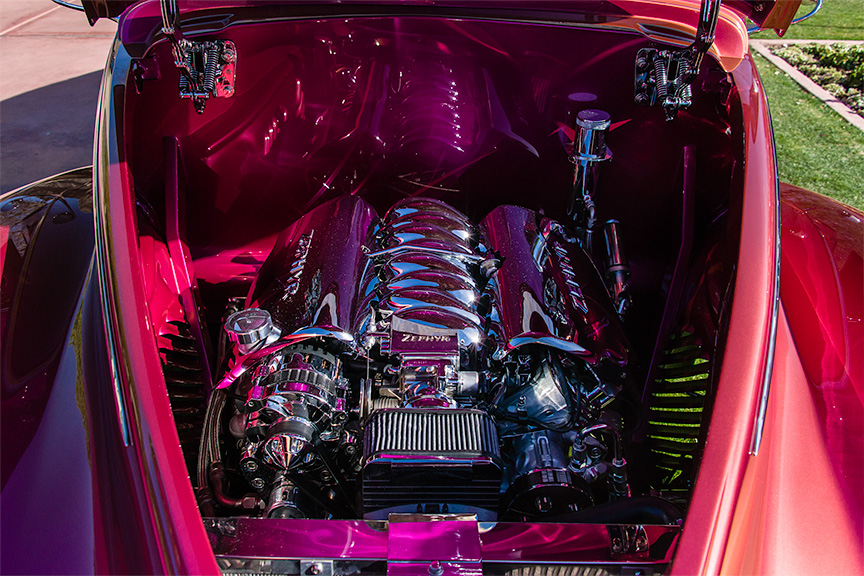 Beneath the hood, power is supplied by a 405 horsepower 5.7-liter LS6 V-8 engine from a 2004 Chevrolet Corvette Z06. It has been upgraded with Street & Performance chrome pulleys, an alternator, accessories, and a wiring harness. The engine is also fitted with custom-made chrome-plated upper injector covers, giving it a clean and classic look. The 2½-inch custom tube exhaust is Jet Hot-coated and fitted with performance headers that cleverly exit through a custom chrome Dagmar rear bumper. An 18-gallon polished stainless steel fuel tank has also been fitted. The transmission is a 2002 Corvette 4L60 four-speed automatic transmission with overdrive and an electronic pushbutton shifter.
 One very curious aspect of this car was the incredible Sundown Cinnamon color-shift finish. When I first started working on the image in Photoshop, I thought I had a problem because the color was not consistent all over the vehicle. It appears that this special finish gives that appearance intentionally.
Expected selling price was $200K to $250K. The actual selling price was $154K.
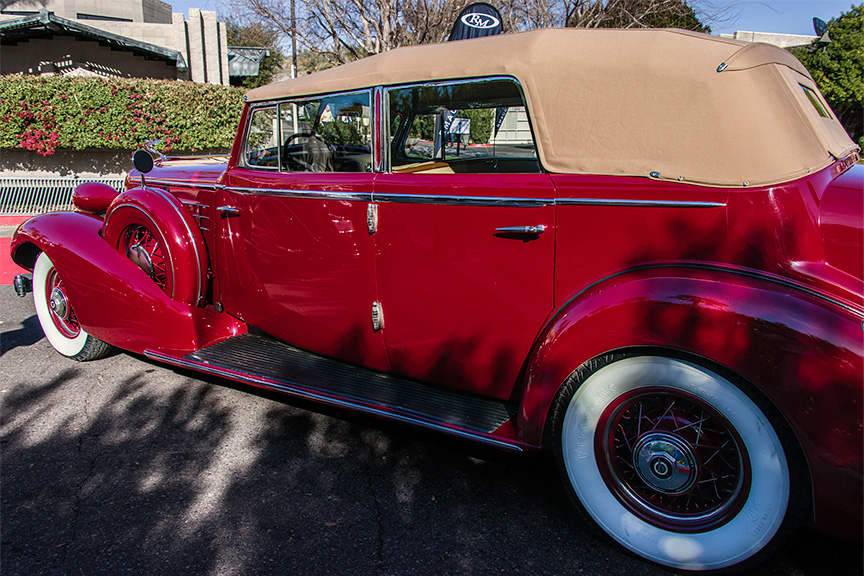 The next vehicle was a 1935 Cadillac V-12 Convertible Sedan — Model 370-D. Series 40. 150 hp, 368 cu. in. OHV V-12 engine, three-speed selective synchromesh transmission, independent front suspension with coil springs, ¾-floating rear axle with semi-elliptic leaf springs, and four-wheel vacuum assisted mechanical brakes. Wheelbase: 146 in.
Expected selling price: $85K - $115K. Actual selling price: $99K.
 The next auto certainly caught my eye — 1939 Alfa Romeo 6C 2300B Corto Spider — 76 hp, 2,309 cc double overhead camshaft inline six-cylinder engine, four-speed manual gearbox, four-wheel independent suspension, and four-wheel hydraulic disc brakes. Wheelbase: 3,000 mm.
 Interesting back story — In the twenties and thirties, Alfa Romeo was equivalent to today’s Ferrari, and more, it was supplying not only competitive rides for the best drivers, but also a steady stream of beautifully engineered and constructed cars for private entrants.
When the company, which employed thousands of artisans, mechanics, and functionaries to build only a few cars, encountered the inevitable financial difficulties, it was bailed out by the state. Instead of being directed to downsize and build saleable automobiles to generate cash flow and keep those thousands employed, Italy directed Alfa to build great racing machines to demonstrate Italy’s technology and competitiveness on Europe’s race courses. Production shrank, but the few cars that were built were the best in the world.
Expected selling price: $500K to $700K. Actual selling price: $440K.
BTW, I have a birthday coming up in April in case you're stumped for a gift. Don't you think I'd look good tooling around town in this baby?
 This is a rare find — a 1937 Cord 812 Phaeton
— 125 bhp, 288 cu. in. L-head V-8, four-speed pre-selector manual transmission, independent front suspension, rear semi-elliptic suspension with leaf springs, and four-wheel hydraulic brakes. Wheelbase: 125 in.
This is a rare find — a 1937 Cord 812 Phaeton
— 125 bhp, 288 cu. in. L-head V-8, four-speed pre-selector manual transmission, independent front suspension, rear semi-elliptic suspension with leaf springs, and four-wheel hydraulic brakes. Wheelbase: 125 in.
The 810 was E.L. Cord’s second attempt at a front-wheel drive automobile. Its engine was a V-8, by Lycoming, but a four-speed electrically-shifted pre-selector transmission was used. The body, designed by Gordon Buehrig, was a thing of beauty. Its blunt, louvered hood gave rise to the nickname “coffin nose,” always a term of endearment, and such features as a “step-down” floor, unitary construction, hidden door hinges, and a total lack of running boards were all previously unheard-of.
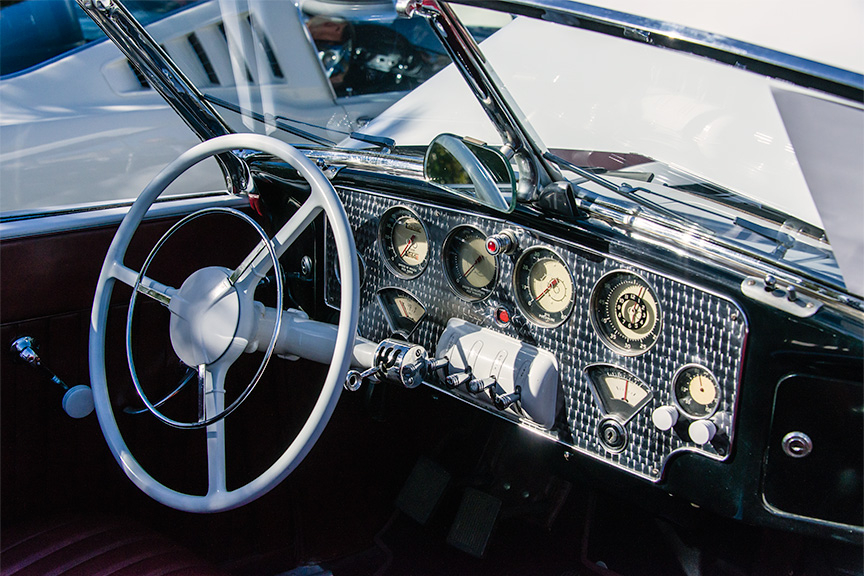 The car’s reception at the November 1935 New York Auto Show was enthusiastic, with onlookers reportedly standing on the roofs of other cars just to catch a glimpse, and the orders poured in. Alas, production start-up for the advanced and complex design was slow, and by the time supply caught up with demand, some customers had changed their minds.
Estimated selling price: $175K - $225K. Actual selling price: $121K.
We end this week with a 1938 Rolls-Royce Phantom III Sedanca de Ville — 165 hp, 7,340 cc OHV V-12 engine with dual ignition, separate four-speed manual gearbox, independent front suspension by coil springs, live rear axle with semi-elliptic leaf springs, and four-wheel servo-operated drum brakes. Wheelbase: 140 in.
In 1935, Rolls-Royce replaced the Phantom II with its first 12-cylinder model, the Phantom III. More compact than the straight-six Phantom II engine, the firewall could be moved forward about eight inches, allowing coach builders to create more spacious passenger compartments. The Phantom III chassis was massively overbuilt, providing a strong platform for large bodies. The forward position of the engine allowed for many innovative body designs, though most PIIIs were formal town cars and limousines, not stylish Sedancas, such as this example.
The PIII was well-received by well-heeled buyers, and the British magazine The Autocar published an extensive road test of it in its October 2, 1936 issue, sub-titled, “Road Travel In Its Most Advanced and Refined Form Provided by the New Twelve-Cylinder Model.”
Expected selling price was $170K - $220K. Actual selling price was $112.75K.
