Musical Instrument Museum, Part 17
 Swiss music brings together sounds seeped in German, French, Italian and Romansh cultures, as well as in religious traditions. The country's alpine folk music, with yodeling, cowbells and alphorns, has helped create a distinct Swiss identity.
Light-weight cast-metal cowbells were practical and effective for tracking livestock. Oversized cowbells hammered from sheet metal were ever-present in parades, weddings and festivals. The cloche bell shown here was made in the glocken (cast) style.
 A traditional alphorn (shown here) is created from a pine tree curved under pressure of snow on a hillside. The tree is cut in half, hollowed and bound together with strips of bark. Modern alphorns are also fashioned from carbon fiber and integrated into pop and avant-garde Swiss music.
 Ireland's vibrant traditional music evolved over many centuries, with the harp becoming the country's national symbol. During the 1970s, an Irish musical revival took place spearheaded by popular bands. In addition to traditional pipes, wooden flutes, bodhran (frame drum), fiddle and accordion, musicians added instruments from elsewhere. Pictured here is a duct flute, commonly called a pennywhistle after its original price.
 Perhaps it is a cliché, but I always associate the concertina with Irish music. In fact, the concertina was developed in England and Germany, most likely independently.
Although the concertina has a resemblance to the accordion in both appearance and sound, there are some important differences. For instance, the buttons travel in the same direction as the bellows unlike accordion buttons which travel perpendicularly to it. Also, each button produces one note, while accordions typically can produce chords with a single button.
 From folk sessions to punk-rock gigs, the do-it-yourself spirit runs high in British musical life. Nonprofessional musicians from local communities form the ranks of choirs and brass bands that are often sponsored by towns, factories and civic organizations.
The do-it-yourself music craze provided early performance opportunities for major British musical artists such as the Beatles, Led Zeppelin and David Bowie. British popular music has been a huge export ever since the 1960s.
Pictured here is one of the old-time instruments, the serpent (bass horn) which is considered the "grandfather" of the tuba. It was originally used in churches then in the mid-18th century, military bands adopted it. It was replaced by valved instruments in the 19th century.
 Everyone recognizes the harp — but did you know it is one of the oldest forms of musical instruments in the world? The oldest found so far were uncovered in the ruins of ancient Sumer (southern Mesopotamia, largely modern-day Iraq).
Harps have evolved into large concert varieties such as the one pictured here from small instruments that could be played in the lap. Have you ever wondered about the unusual curve of the neck? It is a result of the proportional shortening of the basic triangular form so that the strings are equidistant. If the strings were proportionately distanced, the strings would be farther and farther apart.
Also, did you know that the body is hollow and resonates, projecting sound both toward the player through openings, and outward through the highly flexible sounding board. Additionally, at the base are seven pedals, which activate the rods when they are downwardly pressed. The modern sophisticated instrument spanning 6 1/2 octaves in virtually all keys was perfected by the 19th-century French maker Sébastien Érard.
 Pictured here are three flageolets, the two on the left are single and the one on the right is double. Its invention is ascribed to the 16th century Sieur Juvigny in 1581. It had 4 holes on the front and 2 on the back. The English instrument maker William Bainbridge developed it further and patented the "improved English flageolet" in 1803 as well as the double flageolet around 1805. They were continued to be made until the 19th century when it was succeeded by the tin whistle.
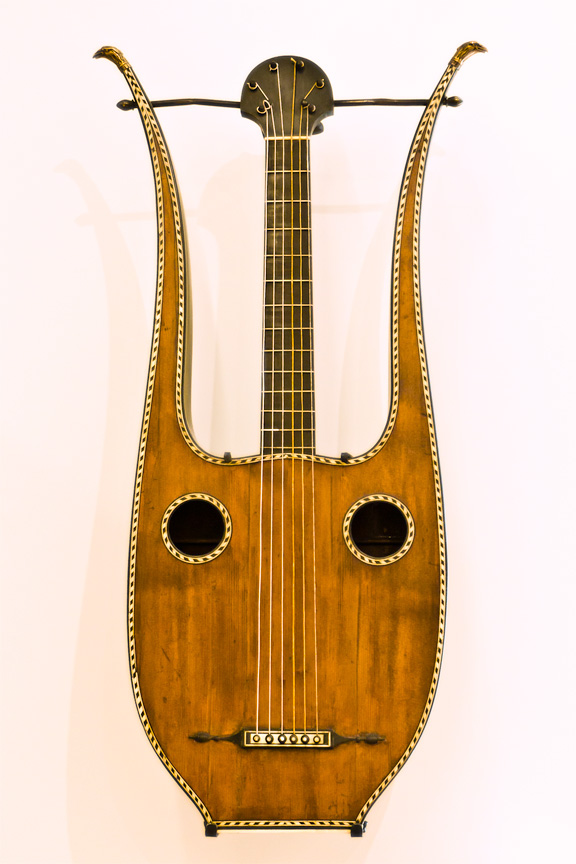 Women are closely associated with two instruments that exemplify French instrument making. The plucked dulcimer is one of those rare folk instruments played by women as are lyre guitars (shown here), which were mainly seen in the hands of wealthy young ladies. Popular in the early 19th century, lyre guitars lost their attraction when these young ladies turned to the conventional guitar and, more often, the piano.
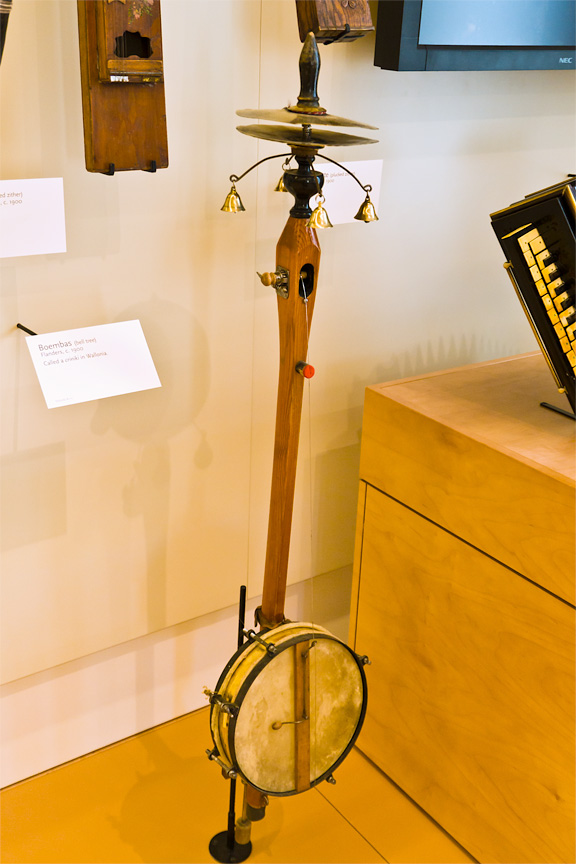 During the 19th century, accordions, brass and woodwinds began to displace traditional Belgian instruments as makers with new and diverse skills set up shop. Bagpipe, violin and hurdy-gurdy ensembles had accompanied rural dances — but by about 1900, the accordion had replaced the bagpipe. In addition, the oompah of the boembas (AKA percussive stick zither, pictured here) often joined such ensembles. I think a boembas would be right at home in an American country jug band.
 Also from Belgium are two valved trombones and a piccolo trumpet. Looks to me to be a set of instruments painted by Salvador Dali — quite unusual shapes to the tubing.
 Saint Hubert, the patron saint of the hunt, is venerated in Luxembourg and in neighboring regions. The forests of the Ardennes region in Luxembourg and in parts of Belgium and France have long been popular hunting grounds.
European hunting horns come in a number of regional types, all shaped for convenient carrying on horseback. These horns serve to round up the dogs with a signal similar to the human voice but with a sound that carries further. Players use their lips to create pitch changes on these valveless horns, sounding motifs called "recheats".
A carillon is a set of tuned bells operated by a keyboard which is struck with the fists. The bells and keyboard are usually housed in a belfry, which is why carillons are poetically called "singing towers". The Flemish carillon tradition, beginning in the 1400s and centered in the Netherlands, Belgium and northern France, became the global model.
Because bells often were melted down during times of war to make armaments, the survival of these bells is particularly striking. Today, the Netherlands has the largest concentration of carillons in the world.
To be continued.
